

As a business owner or facility manager, you have two main goals: growing your business and ensuring the safety of everyone who walks through your doors. Yet, a vital link in this chain of responsibility is often overlooked and relegated to a simple notepad sitting on a dusty counter. We are talking about the visitor log.
In 2026, given the various threats businesses face, paper logs are no longer enough. Whether dealing with fire safety, health risks, or the threat of personal data theft, you can no longer rely on records that can be lost, stolen, or destroyed.
In this article, we will explain why the visitor log has become crucial for your business. To help you see things more clearly, we will break down all the legal obligations surrounding this document. By the end of this article, we will show you how digital technology and the Deemply ecosystem will transform your visitor management into a powerful management tool.

What is a visitor log?
A visitor log is more than just a list of names scribbled on a loose sheet of paper or kept in a binder. It is the document that provides traceability for entries and exits. It officially records everyone outside your company who is currently on your premises. The people you need to record in your log include:
- The clients and prospects coming for a meeting.
- The service providers and maintenance technicians.
- The candidates coming for a job interview.
- The delivery personnel or couriers accessing storage areas.
- The partners or auditors.
In short, the visitor log is your company's memory. Beyond the administrative aspect, you should view this document as your ally in tracking visitor flow. It allows you to know exactly who met whom, at what time, and for what purpose. In the event of an incident, you will be able to act quickly and identify who is on-site. Without it, you risk losing track of people on your premises and exposing them to very serious dangers.

What should it contain?
A visitor log should include the following information:
- The visitor's identity, including first and last name.
- The organization they represent, typically indicated by the company name.
- The purpose of the visit.
- The person being visited at your company.
- The precise timestamp, including the arrival time and departure time of the visitor.
- The acknowledgment of safety instructions, as you must be able to prove that the visitor has understood the rules they are required to follow.
What is the framework for a visitor log?
Who does this apply to?
A visitor log is not strictly mandatory in the sense that it is not explicitly required by law. However, it is highly recommended to implement one for the following types of businesses:
- Public-facing facilities, or establishments open to the public
- Workplace facilities, or establishments that host employees
However, please note that if you create a visitor log, you are collecting personal data. Therefore, you must strictly comply with GDPR. Since May 2018, the General Data Protection Regulation has governed the storage and dissemination of personal data.
GDPR requirements
To ensure GDPR compliance, you must adhere to the following:
- Data confidentiality: A visitor must not be able to read the information of another visitor.
- The right to be informed: You must inform your visitor of the purpose of the data collection and how long their information will be kept.
- The right to erasure: You cannot keep visitor data indefinitely.
Given these obligations, the limitations of paper logs are clear. How can you prevent a visitor from reading the entry above theirs in a notebook? How can you securely delete data within the required timeframes? And above all, how can you be sure the notebook will never be lost or stolen? Digital solutions are the answer to these challenges.

Digital tools: performance and security
Switching from a paper log to a digital solution is more than just a trend; it is a significant efficiency boost for any business owner.
A modern and seamless reception
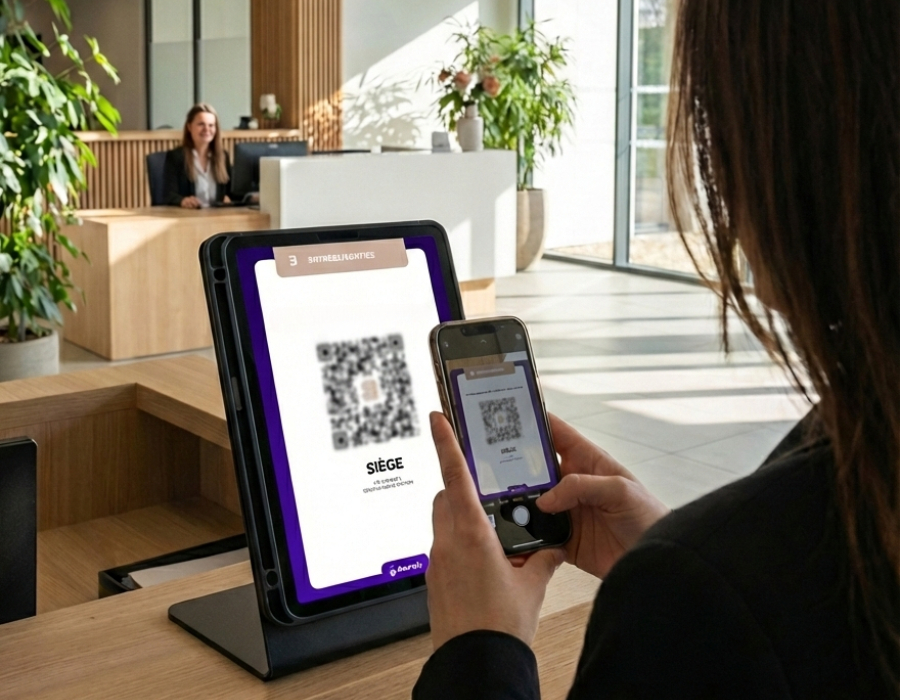
From the moment they enter, the visitor gets a professional impression of your company. No more passing pens from hand to hand or dealing with illegible handwriting. No more forgotten entries, either! With Deemply, visitors can even check themselves in upon arrival, and you have the option to pre-register them before their visit, so they only need to scan a QR code to confirm their arrival. This saves everyone time and keeps your facility secure.
Real-time security
In the event of an alert, there is no need to run and grab the logbook from reception. A digital roll call list is instantly accessible on a smartphone or tablet from the assembly point. With one click, you know exactly who has exited and who is missing. And in an emergency, that makes all the difference, because every second counts.
Going digital also ensures that your visitor log won't be lost to the flames in the event of a fire. You should really view digitalization as a powerful performance driver for your company's security rather than a constraint.
Automation and compliance
With digital tools and the right solution, you can be certain that you will no longer have any compliance issues:
- The data is hidden from the view of other visitors
- The purging of personal data is automated
- Automated notifications keep you and your teams informed about upcoming, ongoing, and overdue visits
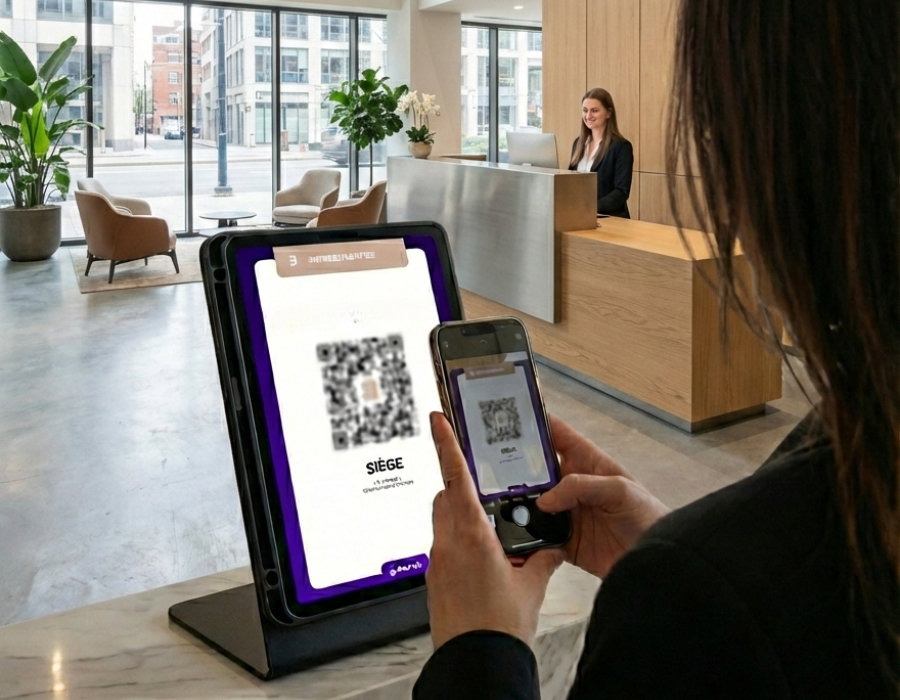
A closer look at the Deemply Check-in/Check-out module
Among the solutions available on the market, Deemply stands out with an approach designed by security experts and tailored to real-world needs. With our check-in/check-out module, we simplify visitor flow management and secure every visit.
The power of QR codes
With Deemply, there is no need to invest in expensive kiosks, tablets, or monitors. A simple QR code displayed at the entrance is all you need. Visitors scan the displayed QR code with their own smartphone, enter their information, and confirm the safety instructions in seconds. It is simple, contactless, and extremely fast.
Centralized multi-site management
For business owners managing multiple sites, Deemply offers a consolidated view. From your dashboard, you can supervise the flow of all your buildings in real time. You can also set up automatic alerts: if a visitor has not checked out after a set period, the system can automatically send a reminder, which saves you from extra mental load.
Integration into a global ecosystem
The strength of Deemply is that it does not treat the visitor log in isolation. It communicates with other modules:
- Safety register
- Building management
- Hot work permits
- Prevention plan
- Accessibility Register
- Health and Safety Log
- Risk Assessment Document
- Form
Choosing Deemply means opting for a simple tool designed for the field, featuring all the modules needed to manage a facility. With the Check-in/Check-out module, you free your reception teams from time-consuming tasks and ensure you stay calm during an incident because you have the right tool to take action.
Conclusion
The visitor log is no longer optional for those who host external guests in their facility. It is the document that ensures your company is prepared for the unexpected. By moving away from paper to a digital solution like Deemply, you choose to protect your visitors and save your staff time.
Ready to take the leap? Schedule your personalized demo with our team.
Switch to paperless compliance
Safety register, DUERP, health booklet: the Deemply ecosystem centralizes your regulatory obligations and alerts you before deadlines.
.avif)

Good to know
Replace this text with the information you want to highlight.
Bon à savoir
Remplacez ce texte par l’information à mettre en avant.