
Article summary
- Any building that employs staff is an Establishment Receiving Workers (ERT), regardless of its size or activity.
- Three categories of obligations: fire safety, DUERP (Single Document for Risk Assessment), and health records.
- Non-compliance can lead to criminal liability for the head of the establishment.
- Deemply centralizes these obligations and sends reminders before deadlines.
Want to go further? Ask
As professionals in safety or building management, many of you have faced the regulatory complexity imposed on Establishments Receiving Workers (ERTs). These obligations affect all roles (HSE, director, site manager, or safety officer), so it is essential to understand everyone's responsibilities and to implement effective tools to avoid wasting energy on a daily basis.

What is an ERT
By definition, establishments receiving workers are buildings where employees are employed. This category applies regardless of the company's size or activity, as specified by the Labor Code. As stated in the text, some establishments have a dual status, also being classified as an ERP (Establishment Receiving the Public).
It is therefore important to keep in mind that all employers are affected, whether you manage an office, a warehouse, a retail store, or an industrial site. As soon as a worker is present, your site is automatically classified as an ERT, and you must meet your obligations, particularly regarding safety.
Obligations to be met in ERTs
In this section, we will explain the three main categories that ERTs must comply with: fire safety, employee safety, and health safety.
Regulatory obligations related to fire safety
In ERTs, as in all buildings, it is imperative to ensure worker safety against fire risks. This safety involves, in particular:
- The implementation of clear safety instructions.
- The periodic inspection of safety equipment such as fire extinguishers, emergency lighting (BAES), smoke extraction systems, etc.
- The conducting of evacuation drills to ensure everyone is prepared in the event of danger.
- Staff training on procedures to follow in the event of a fire.
These obligations are all governed by the Labor Code (articles R.4227 to R-4227-41). Failure to comply can result in criminal liability for the head of the establishment and lead to heavy penalties.
To simplify the tedious management of the safety register, we have created a digital safety register module for you. With its built-in notifications, you or your safety manager will save time and gain peace of mind every day.
The DUERP: An essential requirement
To ensure regulatory compliance for a workplace, it is necessary to create and maintain a Single Occupational Risk Assessment Document (DUERP).
This document is mandatory as soon as an employee is present in the company, as specified by the INRS. With the DUERP, you can record, analyze, and identify risks to implement priority actions to reduce occupational hazards within the establishment.
The DUERP must be accessible to employees and relevant services such as the Social and Economic Committee (CSE), occupational health services, labor inspectors, etc. It must be updated annually or sooner if major changes occur, and must be kept for 40 years.
This document therefore requires rigor and organization to ensure compliance. You can simplify your daily routine by choosing to digitize it with our dedicated module.
Sanitary logbook: A frequently underestimated prevention tool in workplaces
Many establishments that employ workers are unaware that it may be mandatory for them to maintain a sanitary logbook. Indeed, certain actions must be tracked and documented to prove that the health and safety of employees is properly maintained. These actions include:
- Monitoring water quality in certain establishments to combat legionella, among other things.
- The maintenance of ventilation, air conditioning, and extraction systems.
- The tracking of cleaning services for filters, for example.
To track these various actions and be prepared for inspections, you can use a digital sanitary logbook like the one offered by Deemply.

Deemply: The solution designed for field professionals
We know that managing your obligations manually or via Excel files is a real headache. It is time-consuming, a source of errors or oversights, and very difficult to track across multiple sites. The Deemply ecosystem was built specifically to solve these problems.
Deemply is recommended by many safety managers for the following reasons:
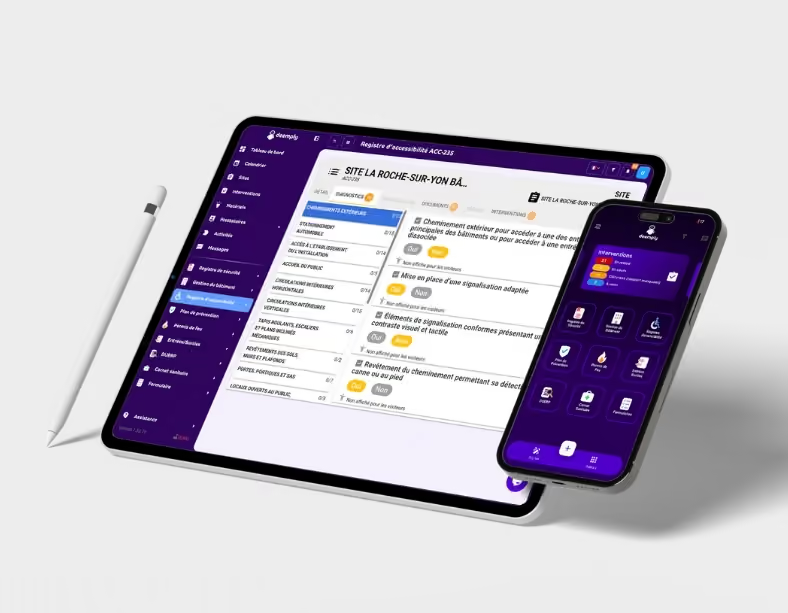
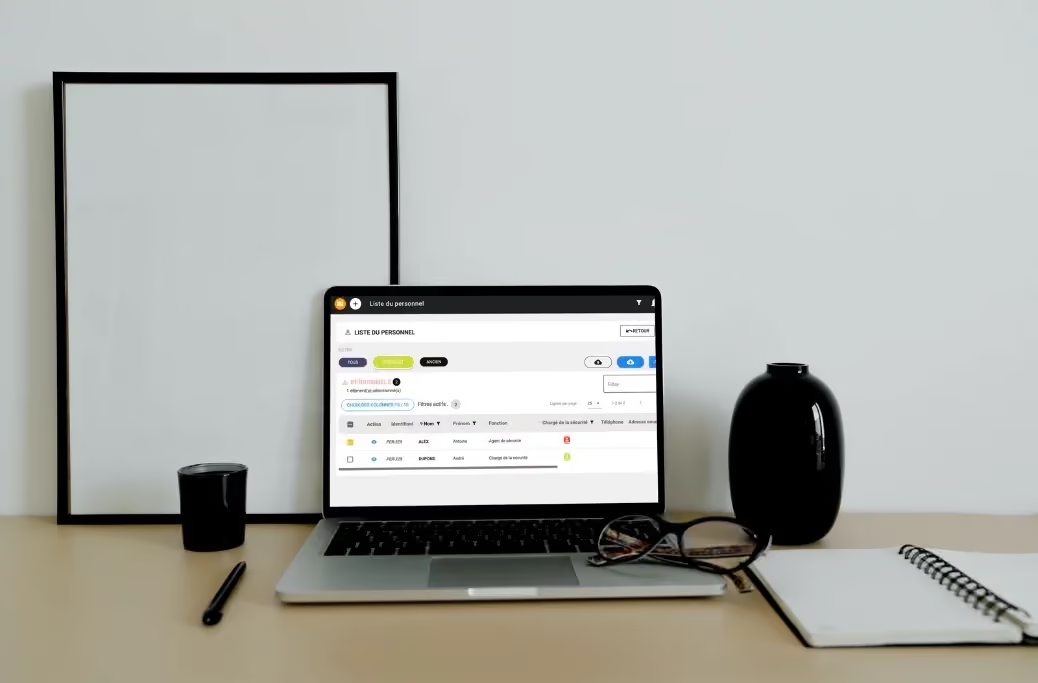
- Centralization of all documents (safety register, sanitary logbook, prevention plan, etc.) in a single intuitive and secure space.
- Automatic reminders that ensure you never miss inspections or any other building safety-related tasks.
- Multi-device accessibility via web access and the mobile app.
- Simplified information sharing internally, as well as with service providers.
- Real-time security monitoring in buildings using filters and color coding.
- Archiving of items with full traceability.
Deemply is truly the essential tool that acts as a co-pilot for facility compliance. The entire ecosystem has been designed with an industry-specific logic that few tools manage to achieve.
Discover the entire Deemply ecosystem
Schedule your personalized demo with our team and don't let the unexpected compromise the safety of your facilities.
Switch to paperless compliance
Safety register, DUERP, health booklet: the Deemply ecosystem centralizes your regulatory obligations and alerts you before deadlines.
.avif)

Good to know
Replace this text with the information you want to highlight.
Bon à savoir
Remplacez ce texte par l’information à mettre en avant.