
Co-ownership associations, property managers, and social landlords have a legal duty of safety as owners of residential real estate. However, tracking fire protection can be challenging in a collective, shared, or even remote management context. In this article, we explain how a digital safety register provides the solution.
Residential buildings and fire safety registers
Maintaining a safety register for residential buildings is required by French law, just as it is for public-access buildings (ERP) and workplaces (ERT). Article R111-13 of the Construction and Housing Code stipulates that every owner of residential property must use this document to provide proof of the existence and maintenance of installations, fittings, and devices put in place to protect residents against fire.
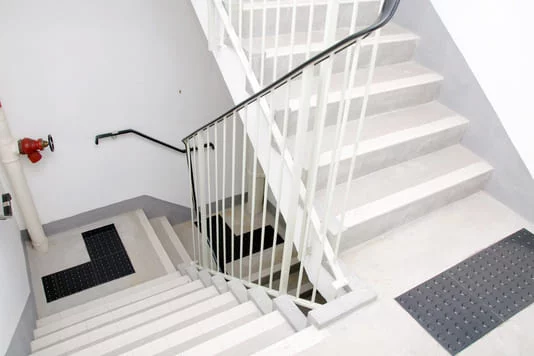
The residential buildings and the rules governing protection against fire and panic risks are covered by the Order of January 31, 1986 regarding fire protection in residential buildings. These include collective housing and medium-rise buildings (IMH, where the floor of the highest dwelling is more than 28m above ground level), as well as covered parking garages attached to these buildings with a surface area exceeding 100m2.
Due to their nature, high-rise residential buildings (IGH, where the floor of the highest dwelling is more than 50m above ground level) are subject to specific rules defined by the Construction and Housing Code (CCH) and the Order establishing safety regulations for the construction of high-rise buildings and their protection against fire and panic risks. They are not exempt from legal safety and inspection measures and must therefore maintain a safety register just like any other residential building (art. R122-29 of the Construction and Housing Code).
Digital register for property managers, co-owners, and social landlords
Safety obligations fall upon co-ownership associations and social landlords as owners of residential buildings. These include posting safety plans and instructions, verifying and maintaining fire detection and suppression systems, and maintaining a safety register to provide proof of these actions to authorities. These obligations may be delegated to a representative designated by the building owner(s): property manager, RUS (Unique Safety Manager, under certain conditions), etc.
Choosing an online safety register and digital management is an ideal solution for co-owners and social landlords. Centralizing data and documents, remote accessibility, task scheduling, shared management, and user profile administration are particularly well-suited for collective and/or remote property management.
Furthermore, a digital register allows property managers to meet the legal obligations defined by the Elan Law, or Law No. 2018-1021 of November 23, 2018, on the evolution of housing, planning, and digital technology. Under this law, property managers must provide co-owners or the co-ownership council with online access to documents related to the management of the co-ownership (art. 205 of the Elan Law). Decree No. 2019-502 of May 23, 2019, which came into force on July 1, 2020, reinforces the Elan Law provision by defining the minimum list of digital documents that must be presented, including:
- The building maintenance log
- Technical diagnostics of common areas
- Maintenance and service contracts for common equipment
To meet safety regulations in full compliance with French law, we invite you to discover Deemply. Our online safety register solution will allow you to manage the safety and fire protection of your residential building with complete peace of mind, while helping you fulfill your legal obligations.
Discover the safety register
In our demo, discover all the features of our fire safety register module.
Switch to paperless compliance
Safety register, DUERP, health booklet: the Deemply ecosystem centralizes your regulatory obligations and alerts you before deadlines.
.avif)

Good to know
Replace this text with the information you want to highlight.
Bon à savoir
Remplacez ce texte par l’information à mettre en avant.