Water quality must be a top priority for businesses, particularly for public-access buildings and multi-unit residential complexes. Water systems can become contaminated with Legionella, a bacterium that poses a significant health risk to those exposed. To prevent these dangers, regulations require the maintenance of a sanitary logbook to rigorously monitor installations.
To better understand the role of the sanitary logbook, this article explores the risks associated with Legionella and how our innovative solution helps you manage this documentation simply and intuitively.
Before we dive into the risks associated with Legionella, it is important to note that the sanitary logbook is not just about water. It is essential for preventing all types of bacteriological risks. This applies to sectors such as food service, public facilities, and hospitals.
What is a water-monitoring sanitary logbook?
A sanitary logbook is generally a document used to centralize all information regarding the management of bacteriological risks within buildings. Regarding water, it is the tool used for management and control. To do this, it must contain the following information:
- Water system specifications, such as network diagrams, equipment types, and supply sources.
- Water analysis tracking, where the results of microbiological and physicochemical samples must be recorded.
- Technical interventions and maintenance operations, such as tank cleaning, descaling, or network disinfection.
- Preventive measures implemented within the facility to limit bacterial growth and ensure safe water.
- Detected non-conformities and the corrective actions taken.
The sanitary logbook is mandatory for many establishments: public-access buildings, hospitals, nursing homes, hotels, swimming pools, office buildings, and condominiums. Poor record-keeping can expose those responsible to penalties in the event of a health incident. If you would like to learn more about the potential penalties, please see this article.
A major health risk: Legionella
What is Legionella?
Legionella is a bacterium that poses no health risk in its natural environment. It is naturally present in fresh water and damp soil. The health risk arises when Legionella develops in artificial water systems, particularly those in buildings. When inhaled in the form of aerosols (water vapor, showers, spas, misting systems, etc.), it becomes dangerous as it can cause a severe lung infection known as legionellosis.
What are the risks of legionellosis?
Legionnaires' disease is a condition that can manifest in two forms. It can be mild, resembling the flu, but can also progress to a severe lung infection that may sometimes be fatal. Several groups are considered at higher risk:
- The elderly,
- Immunocompromised individuals,
- Smokers,
- Patients suffering from chronic respiratory diseases.
In France, hundreds of cases are diagnosed and recorded each year. If contamination originates from a facility that has failed to meet its monitoring obligations, it may be held liable and face legal action.
How does Legionella proliferate?
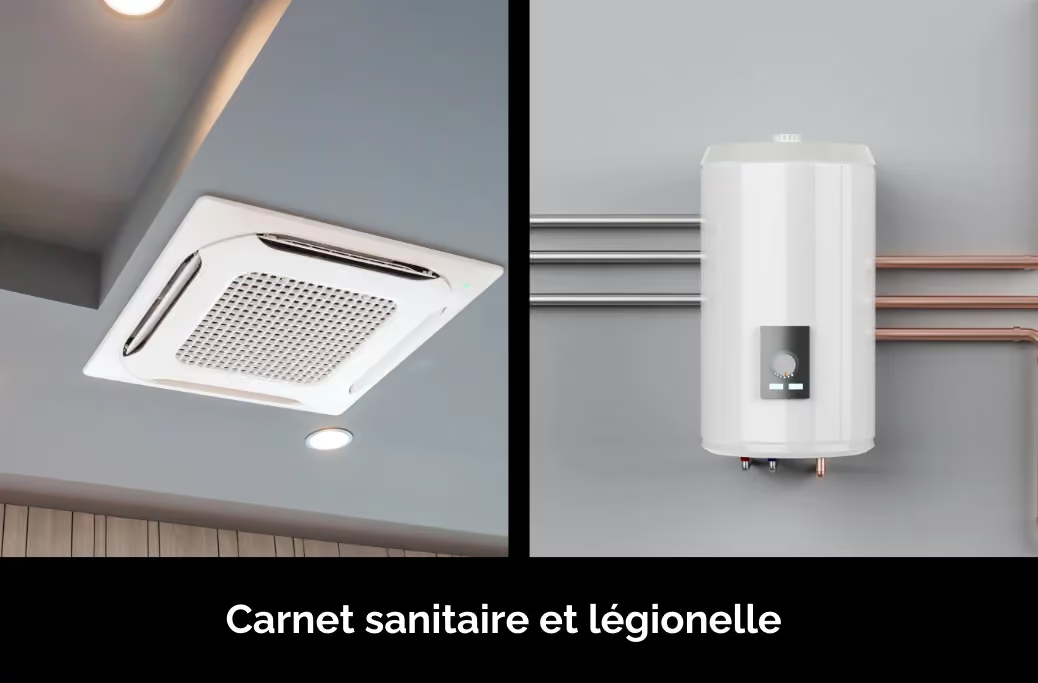
The bacteria associated with Legionella multiply rapidly in stagnant water, particularly when the temperature is between 25 and 45°C. This means that the primary high-risk installations are:
- Hot water tanks,
- Air conditioning systems and humidifiers,
- Cooling towers,
- Showers and taps that are rarely used,
- Hot tubs and spas.
Solutions for preventing Legionella
To prevent and limit the growth of Legionella in order to protect visitors, residents, or patients, several preventive measures can be implemented:
- Monitor water temperature by keeping hot water above 50°C and cold water below 20°C. Checks must be recorded in the facility's health log to prove that measures to limit bacterial proliferation have been properly implemented.
- Avoid water stagnation and regularly flush systems to promote water circulation.
- Perform regular analyses to microbiologically verify that no bacteria are present and to quickly detect potential contamination.
- Maintain equipment with thorough and regular cleaning, including periodic disinfection of tanks, reservoirs, showers, and all other high-risk points.
Whenever one of these actions is performed, it must be recorded in the health log to comply with regulatory requirements.
Why digitize your health and safety logbook?
As with all regulatory requirements, managing a paper health and safety logbook can be complex and tedious, especially for facilities with numerous pieces of equipment to monitor. To simplify this task and ensure perfect traceability for all checks, we at Deemply have developed an intuitive, functional module to streamline your daily operations.
The benefits of the Deemply solution
First, by digitizing your regulatory obligations, you can centralize all your data management. All your documents will be tracked and accessible in one place. No more digging through binders; all information will be available anywhere, in real time.
Automatic reminders will be generated. Thanks to these, you will never miss a thing, as you will be notified of upcoming checks, overdue interventions, expiring contracts, and more.
Real-time tracking of your actions. You can record every action, generate reports, and ensure your facilities remain compliant during scheduled or surprise inspections by the relevant authorities.
Time savings and administrative simplification. Digitization eliminates repetitive tasks through automation and reduces the risk of errors.
Accessibility and security. All data hosted in your Deemply solution is protected and accessible at any time from any device, provided you have the necessary access rights.
Features of the Deemply health and safety logbook module
Within your solution, you can configure all the categories of checks required for your facility. You can intuitively create fully customized documents using fields such as short or long text, hyperlinks, numeric fields, dropdown lists, checkboxes, photos, documents, tables, or even signatures.
To track your equipment, you can create logs that can be set to various frequencies, such as daily, weekly, monthly, bimonthly, etc. You can also specify if checks need to be performed multiple times by adding a recurring schedule.
Finally, you can fill out your logs to perform your checks. You can add information via your web environment or directly on your smartphone using our mobile app. If necessary, you can create work orders to repair faulty equipment.
With the Deemply solution, you won't let managing your health and safety logbooks become a headache. If you would like to learn more, you can contact our team or explore our demos.
Switch to paperless compliance
Safety register, DUERP, health booklet: the Deemply ecosystem centralizes your regulatory obligations and alerts you before deadlines.
.avif)

Good to know
Replace this text with the information you want to highlight.
Bon à savoir
Remplacez ce texte par l’information à mettre en avant.