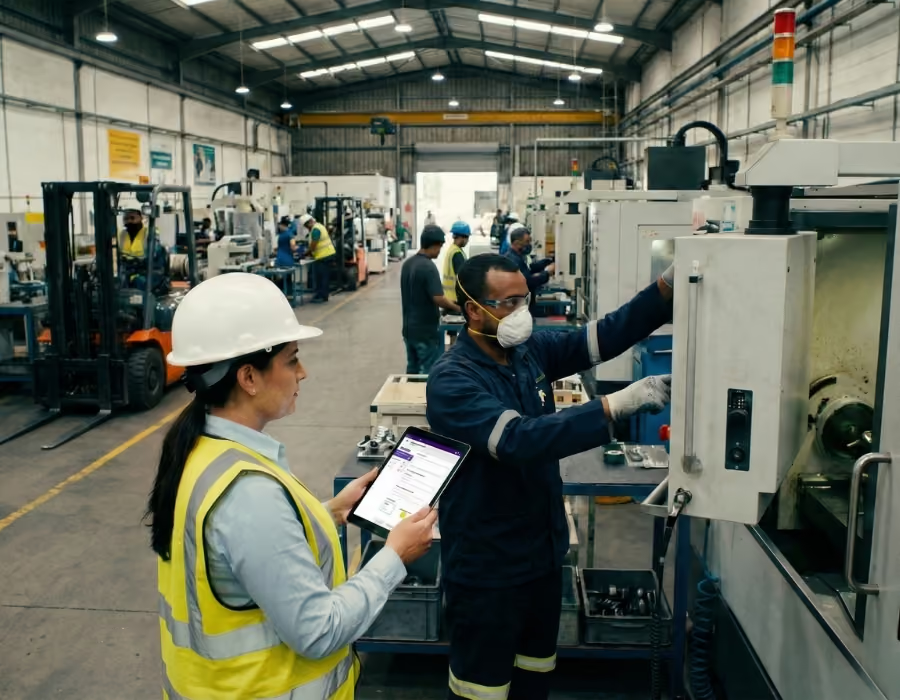

The sanitary logbook is an essential document for businesses, particularly for establishments where the management of water, hygiene, and safety is paramount for visitors and employees. It allows you to centralize all information regarding the maintenance of sanitary and technical installations as well as those performed on various equipment such as refrigerators, cold rooms, etc. The sanitary logbook also consolidates all readings and checks carried out to ensure compliance with current regulations for the prevention of health risks.
In this article, we will cover three main topics:
- The definition of the sanitary logbook in businesses and the sectors that are required to maintain this document.
- The details of the rules governing this document
The benefits of implementing a digitized sanitary logbook
What is a corporate sanitary logbook?
The corporate sanitary logbook is a tracking document. It is designed to ensure the traceability and compliance of sanitary and technical installations, as well as various building equipment. It specifically concerns:
- Drinking water and domestic hot water (DHW) networks.
- Air conditioning and ventilation systems
- Heating and water distribution systems
- Equipment subject to maintenance requirements such as swimming pools, showers, tanks, etc.
- Equipment in contact with food products
- Equipment ensuring compliance with the cold chain
- Etc.
Simply put, the sanitary logbook ensures the traceability of all equipment deemed sensitive to the risk of bacteriological contamination. It is primarily implemented in businesses and public-access establishments (ERP), the food industry, hospitals, schools, and any facility where compliance with hygiene and sanitary standards is essential.
Objectives of the corporate health and safety logbook
As mentioned above, the primary objective of the corporate health and safety logbook is to identify and manage risks related to water, air quality, and the hygiene of various technical installations. It helps to:
- Prevent bacterial contamination, such as Legionnaires' disease, a serious illness that can spread through poorly maintained water systems.
- Ensure the sanitary quality of all installations, by using inspection procedures to verify that equipment meets current standards.
- Facilitate the tracking of maintenance work, including equipment cleaning, disinfection, water analysis, replacement of faulty parts, and more.
- Prove the compliance of installations and equipment, as the health and safety logbook is the document to present during inspections by health authorities or internal audits to demonstrate the facility's compliance.
Contents of the corporate health and safety logbook
The corporate health and safety logbook contains several types of essential information:
Identification of the relevant installations
It should include a detailed description of the monitored equipment: water systems, boilers, refrigerators, cooling towers, etc., and the precise location of the installation within the building.
Maintenance history
For every intervention performed, the following should be recorded in the health and safety logbook:
- The date of the various maintenance and servicing operations
- The type of intervention performed: cleaning, disinfection, repair, replacement, etc.
- The results of inspections and health analyses
Health management guidelines
This section includes the frequency of inspections and preventive maintenance, as well as the preventive measures for health risks that must be followed. This is where, for example, information regarding the use of gloves would be recorded. Finally, it will outline the action plan to be implemented if anomalies are detected.
Regulations governing the corporate health and safety logbook
The implementation of a health and safety logbook for managing installations and equipment is subject to and governed by several regulatory texts. Failure to comply with these obligations exposes facility managers and employers to administrative and criminal penalties.
Regulatory obligations regarding health management
1. Regulations regarding water management and Legionella prevention
Three major texts govern prevention regarding water quality:
- The Decree No. 2001-1220 of December 20, 2001, imposes obligations on companies to monitor hot water production and distribution systems. The goal is to reduce the risks of bacterial proliferation, particularly Legionella.
- The Order of February 1, 2010, sets the regulatory thresholds for Legionella concentration and the corrective actions to be implemented if the bacteria are detected in the water system.
The Public Health Code, articles R1321-1 to R1321-66, regulates drinking water quality and mandatory health inspections.
2. Specific obligations for public buildings (ERP), workplaces (ERT), and high-risk businesses
Due to the visitors or employees present in these establishments, several regulations must be followed:
- Article R4225-2 of the Labor Code requires employers to ensure that employees have access to safe, potable water.
- The NF T90-431 standard specifies the methods for analyzing Legionella in water systems.
3. Obligations for maintaining the cold chain
- The order of December 21, 2009 specifies the obligations for retail businesses. It includes information on complying with temperatures based on the type of food products.
Penalties for non-compliance with health obligations
As with any regulation, failure to comply poses a risk to the establishment's manager. For the corporate health logbook, the potential penalties are as follows:
- Administrative fines.
- The temporary or permanent closure of the establishment if a health risk is confirmed.
- The liability of the establishment manager or employer may be called into question in the event of poisoning or illness contracted by a visitor or employee.
The benefits of digitizing your corporate health logbook
Technological advancements have positively impacted many sectors, starting with corporate safety. Today, many companies are choosing to adopt tools that make their daily lives easier and help them increase productivity. This is the case with the digital health logbook that we offer. With Deemply, you will improve the management of your health obligations, simplify your inspections, and ensure the traceability of your operations.
Improve the monitoring and traceability of your operations
By digitizing your corporate health logbook, you will benefit from several daily advantages:
- Improved information accessibility. Within your Deemply space, you can consolidate and centralize all your information in a single environment. Plus, with our mobile app, you can access information on the go directly from your smartphone.
- A detailed and structured history. Every intervention and action you take regarding your health and safety log is recorded and tracked within your Deemply ecosystem.
- Automatic and customizable alerts. You are notified as soon as an intervention is overdue or a check is missing. Thanks to these notifications, you will never miss a detail and can take the necessary actions or follow up with your service providers or staff.
Reduction of errors and oversights
To err is human, but when it comes to safety, there is no room for error. With digitalization, you can:
- Eliminate paper documents that can easily be lost or altered.
- Automate reminders for periodic checks and maintenance. With this automation, you no longer need to worry about remembering tasks. The Deemply solution handles event and schedule reminders for you.
- Generate real-time analyses necessary for maintaining safety.
Peace of mind for audits and regulatory inspections
We know that facility inspections can be stressful when dealing with paper documents that might be lost or incomplete. Our tool gives you peace of mind because:
- Access to information is fast, so you don't have to hunt for documents during inspections.
- Generating various summaries is easy, and you can send them to the relevant authorities to prove your compliance with current standards.
Time savings and real cost optimization
You may be wondering about the benefits of investing in a tool like the one Deemply offers. Rest assured, you will save money because:
- You will reduce costs related to printing and archiving all your regulatory requirements currently kept on paper.
- Technical intervention management will be more efficient, preventing costs associated with unnecessary repairs or issues caused by poor equipment maintenance.
- Human resources in your facilities will be optimized through better task planning and process automation.
Conclusion
The health and safety log in a company is an essential document and tool for ensuring the sanitary safety of facilities and guaranteeing the safety of your visitors and employees. It is what enables your regulatory compliance. Rigorous management helps avoid and prevent health risks, particularly those related to water quality and the maintenance of all technical equipment.
Thanks to digitalization and Deemply, this document is even more effective, thanks to real-time tracking, better traceability, and much more efficient management. All companies subject to health and safety log requirements benefit from adopting a digital tool to optimize costs and easily comply with legal obligations, while gaining productivity and peace of mind.
To get a quote for your company's health and safety log, contact our team at 02 51 62 45 08 or via the form.
Discover the health and safety logbook
In our demonstrations, you will be able to explore all the features of the health and safety logbook module. You will also have the opportunity to discover all the other modules within the Deemply ecosystem.
Switch to paperless compliance
Safety register, DUERP, health booklet: the Deemply ecosystem centralizes your regulatory obligations and alerts you before deadlines.
.avif)

Good to know
Replace this text with the information you want to highlight.
Bon à savoir
Remplacez ce texte par l’information à mettre en avant.