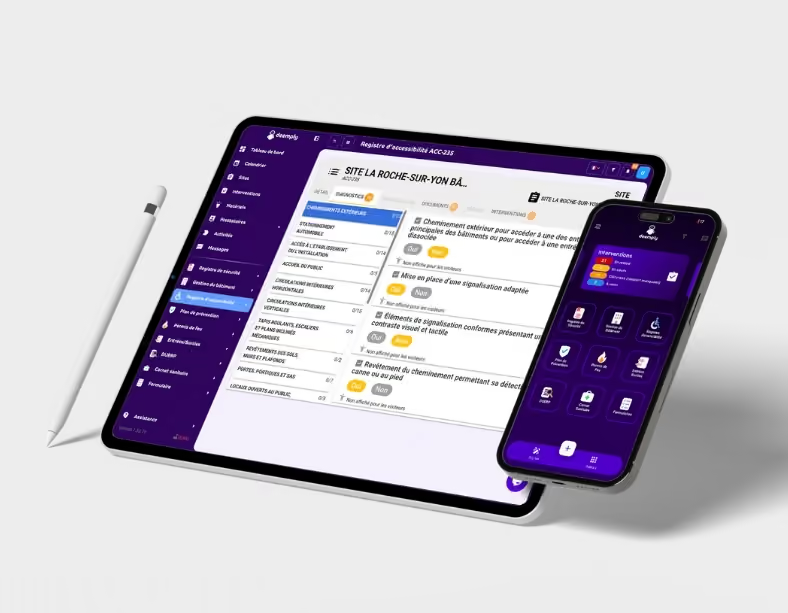

The risks associated with not having a corporate health and safety logbook should not be overlooked. In today's climate, where health concerns play a central role in business management, maintaining a health and safety logbook is essential to mitigate microbiological risks. It is clear that this document is often misunderstood or neglected by many organizations, even though it is a vital component of health and safety policy for any facility that must monitor cold chains, water systems, or air quality. The absence of a corporate health and safety logbook can lead to serious consequences on several levels.
In this article, we will explain in detail what a health and safety logbook is. We will then analyze the risks companies face if they do not have one. Finally, we will highlight the benefits of a digitized health and safety logbook and the advantages it offers your business.
What is a corporate health and safety logbook?
Definition and regulatory framework
It is important to remember that the health and safety logbook is a mandatory document that consolidates all information regarding the monitoring and maintenance of all installations that may pose health risks. The corporate health and safety logbook is used by and mandatory for public-access buildings (ERP). This tool ensures traceability by centralizing all control records, maintenance logs, and upkeep operations.
Regulations governing the corporate health and safety logbook are based on several laws, decrees, and orders. These include the order of February 1, 2010, which addresses the monitoring of Legionella in domestic hot water systems (showers, hot water tanks, hot tubs, etc.). This requirement therefore applies to many establishments such as swimming pools, nursing homes, hospitals, and more. The Public Health Code, specifically articles L.1321-1, defines the rules for water intended for human consumption. For healthcare facilities, the order of November 30, 2005 specifies the additional measures to be implemented for water quality.
In summary, we can define the health and safety logbook as “an essential risk management tool that ensures the traceability of maintenance and monitoring operations,” as per circular DGS/SD7A/SD5C-DHOS/E4 No. 2002-243 of April 22, 2002.
The contents of a health and safety logbook
For your health and safety logbook to be complete, it must include several essential elements:
- A description of the installations, including water network plans, schematic diagrams, and the technical specifications of the equipment.
- The preventive maintenance program, which includes the schedule of planned interventions and maintenance procedures.
- The results of microbiological and physicochemical analyses, where you record Legionella test results, temperature readings, and chlorine levels.
- The intervention register, where all corrective maintenance operations and modifications made to the installations must be recorded.
- The risk management procedures, where you consolidate all intervention protocols in the event of contamination and emergency measures.
- The administrative documents, which include, for example, certificates of compliance, service provider certifications, and official approvals.
As the ARS (Regional Health Agency) states in its best practices guide: "The health logbook must be regularly updated and accessible to health authorities during inspections. It serves as a record of the installations and ensures continuity in their monitoring."
Risks incurred by companies without a health logbook
Any company that does not maintain a health logbook or keep it up to date faces multiple risks. The consequences can be particularly severe if a health issue arises. We can classify these risks into four main categories: health, legal, economic, and reputational.
Health risks
Without regular monitoring of installations, the risk of pathogenic organisms proliferating increases significantly. Legionnaires' disease, which is caused by the bacterium Legionella pneumophila, is one of the main threats in poorly maintained water systems. According to Santé Publique France, there are approximately 1,800 cases of Legionnaires' disease per year, some of them resulting in death following contamination. This figure shows the importance of keeping a health and safety logbook up to date to limit risks. Without one, early detection of contamination is impossible.
Legal and regulatory risks
Regulatory non-compliance
The absence of a health logbook constitutes regulatory non-compliance. Indeed, under Article L.1324-3 of the Public Health Code, failure to comply with provisions regarding water quality is punishable by one year of imprisonment and a 15,000 euro fine.
For installations classified for environmental protection (ICPE), such as cooling towers, penalties can be more severe. Article L.173-1 of the Environmental Code provides for up to two years of imprisonment and a 100,000 euro fine for failure to comply with applicable requirements.
Liability in the event of an accident
If contamination leads to harm for users or employees, the absence of a company health logbook will be considered an aggravating factor against the operator. Case law shows that courts view this absence as clear negligence. For instance, in a ruling by the Lyon Court of Appeal on September 28, 2013, judges held a thermal establishment liable in a case of Legionnaires' disease. This decision was based on "the lack of traceability of maintenance and control operations, demonstrating a clear failure in supervision."
Difficulties with insurance
Some insurance companies include exclusion clauses that void coverage in the event of a claim if they determine that the company has failed to meet its legal risk prevention obligations. As noted above, the absence of a company health logbook can be categorized as a failure to fulfill these obligations.
Economic risks
Direct costs in the event of contamination
Interventions following contamination are far more complex and costly than maintaining a company health logbook. According to a study by the National Research and Safety Institute (INRS) published in 2020, "the average cost of decontaminating a domestic hot water system is 2.5 times higher when the establishment does not have an up-to-date health logbook to precisely target interventions."
These costs include: emergency microbiological analyses, shock treatments (such as chlorination and thermal shocks), network disinfection, potential equipment replacement, and operating losses due to temporary closure.
Administrative sanctions and penalties
The fines mentioned above are not the only possible sanctions. Health authorities may also impose binding administrative measures, namely:
- Formal notices to comply.
- A temporary or permanent administrative closure.
- A suspension of operations.
The ARS may also impose enhanced inspections, the costs of which are billed to the operator. These inspections are carried out if deficiencies are identified within the facility.
Impact on productivity
If contamination is detected, for example in water systems, it can lead to a partial or total interruption of operations at your facility. This closure of your building will result in a decline in your productivity and profitability.
Reputational risks
Damage to company image
In today's digital age and given recent events, a health crisis can quickly tarnish a company's reputation. Indeed, the National Consumer Institute (INC) points out that "80% of consumers state they would avoid an establishment that has been involved in a health scandal, even after the issue has been resolved" (Consumer Confidence Barometer, 2022)
Loss of partner trust
Business partners, professional clients, and suppliers may also question their collaboration with a company that fails to meet its fundamental health obligations.
The benefits of a digital health logbook for businesses and risk elimination
Beyond simple regulatory compliance for the facility, implementing and maintaining a health logbook via a digital tool provides numerous advantages for operations managers.
Optimization of preventive management
Automatic scheduling of inspections
A well-structured health logbook allows for the creation of a precise schedule of preventive inspections to be carried out. With a tool like the one offered by Deemply, the operator can anticipate needs and ensure that all equipment is in good working order.
Early detection of anomalies
Systematic recording of inspections and results makes it possible to identify very quickly if a risk is present. Indeed, if an anomaly is present, it is possible to limit the proliferation of bacteria and stop contamination.
By regularly checking installations, you will avoid emergency corrective interventions, which are often costly and disruptive to the smooth operation of the building.
Simplification of daily work
Centralization of information
The digital health and safety logbook for businesses centralizes all facility-related data into a single environment. This saves operations managers from having to search for information in piles of documents where details are sometimes erased or even lost. This centralization also helps simplify communication with staff, as information can be shared easily. This smoother flow of information helps improve relationships among team members.
Automated alerts and reminders
Within your Deemply environment, you can set up reminders and notifications that let you know which inspections are due, which are overdue, and which are coming up.
This automation helps reduce the risk of oversight and allows operations managers to focus on higher-value tasks rather than tedious and redundant administrative work.
Mobility during inspections
With the mobile app developed by our team, you can record all your inspections directly on your phone. This mobility allows you to add all information at the moment of the check. Thanks to the app, you will no longer forget details, as everything will be automatically saved in your environment.
Multi-user management
In your Deemply environment, you can create accounts for all users who will be involved with your health and safety logbook. For each one, you can define permissions and grant or restrict their ability to perform certain actions. For example, you can choose to allow some to create records, others to update procedures, and others only to view specific information. Everything in your space is customizable, allowing you to manage your health and safety logbooks according to your facility's needs.
Manage all your sites in one environment
In your space, you can manage the health and safety logbooks for all your sites. For each one, you can create the necessary user accounts. If needed, you can grant full permissions to all users as we saw previously, or assign specific rights only to those who need access to the information.
All your compliance in one intuitive tool
The Deemply solution is more than just a health and safety logbook management tool. In your space, you can manage 8 other modules, namely:
- The safety register, which is dedicated to companies where contractors/businesses come to inspect safety equipment such as fire extinguishers, fire alarms, or electrical installations. They may also come to train staff. During these visits, they must sign the safety register to provide proof of their attendance.
- The building management module, which allows you to handle various building issues such as a broken door, a burnt-out lightbulb, or clogged toilets. It also allows you to manage contractors and companies under contract for various services: landscaping, boiler maintenance, etc. You can centralize information and ensure follow-up in one single place.
- The accessibility register is dedicated to public-facing establishments that must make available to visitors, especially those with disabilities, information on access methods and implemented facilities.
- The hot work permit, which is to be used in companies that bring in contractors to perform work involving heat sources. This is the case, for example, when a blowtorch or an angle grinder is used.
- The prevention plan is useful for companies that have external contractors performing various tasks such as construction, maintenance, cleaning, etc. In this document, they can establish the rules to be respected by all parties.
- The entry/exit log, or visitor register, is intended for all companies that have visitors such as sales representatives, contractors, or other businesses on their premises. For them, it is essential to know in real-time how many external people are present in the buildings. With Deemply, they can find out with a single click.
- The works module is dedicated to companies that have renovation or construction projects and need to track the stages of these projects to monitor their progress.
- The DUERP (Single Document for Risk Assessment) is intended for all companies in France with at least one employee. They can assess the risks of their employees' work environments and adapt them if necessary.
To conclude, a company health logbook is far more than just a regulatory requirement. It is a vital strategic tool for managing facilities with health risks. Failing to maintain one properly exposes the company to major risks that are entirely preventable.
If you would like to learn more about our company health logbook or any of our other modules, please contact our team at 02 51 62 45 08. You can also contact us here or request a demo.
They trust us!


Technical support
★ ★ ★ ★ ★
A very well-designed, scalable software for managing local authorities.
It’s quite quick to learn, thanks to the staff who provide excellent training. They are also very responsive when answering our questions via chat.
Vihiers Supermarket
★ ★ ★ ★ ★
A very practical tool for our store! Deemply finally allows us to digitize our safety register and track our regulatory checks in real time. Simple, efficient, and a real time-saver for the management team. I highly recommend it!
Thomas Graff
★ ★ ★ ★ ★
A high-performance application that is easy to use, with an extremely responsive hotline.
Frédéric MELET
★ ★ ★ ★ ★
The safety register is a relevant software solution that stands out for its efficient features.
The software centralizes all safety-related information in one place, making data access and management easy. Its user interface is friendly and intuitive, making the software accessible and easy to learn, even for non-technical users.
The safety register proves to be an essential tool for maintaining high safety standards while optimizing processes and ensuring regulatory compliance.
Olivier Baguet
★ ★ ★ ★ ★
A user of the solution for 3 years, with 240 sites deployed. Very efficient and intuitive for perfect safety management. It works for everyone: the administrator who has a complete overview, the local manager who is notified of actions to be taken, and the safety officers who appreciate the digital presentation during safety inspections.
Yves Blanchet
★ ★ ★ ★ ★
High-performance software that makes tracking safety registers easy. Simple access for users and companies to fill them out. A great help with the reminder function for upcoming events and tasks. Unlimited user access.
David Philippe
★ ★ ★ ★ ★
As a user for over 4 years, I can only attest to the exceptional quality of this platform. It is a solution that is both simple and extremely effective. The team answers all your questions via their chat clearly and quickly. Always ready to take our needs into account, they offer tailored solutions that make all the difference.
The various modules available cover a wide range of needs such as building management, the Single Occupational Risk Assessment Document (DUER), check-ins/check-outs, etc. This makes it a complete solution for any company concerned with safety and compliance.
What also sets them apart is their commitment to customer loyalty. Their proactive approach and exemplary customer service help build trust over time. In short, I highly recommend Deemply for any company looking for a reliable and high-performance solution in the field of safety.
Frédéric Ruault
★ ★ ★ ★ ★
After more than a year of use and several safety inspections, the tool is perfectly suited to our needs.
It saves time during safety inspections and is well-liked by safety officers. The Deemply team is very attentive to its users (clients).
A present and responsive team that answers our questions quickly. I recommend it. A product made in France.
Thanks to the whole team.
M. Claude
★ ★ ★ ★ ★
In this digital age, we truly appreciate this software, which allows us to monitor the various registers for our public-access buildings (ERP) across different mountain sites, anytime and anywhere.
As a user for many years, I have appreciated the team's attentiveness and their proactive approach to regularly adding new features to the product.
Sébastien Raynard
★ ★ ★ ★ ★
Comprehensive and intuitive software. A team that is always available to answer my questions quickly. I recommend it.
Collège St Louis - La Roche sur Yon
Mélanie Paillat
★ ★ ★ ★ ★
A team dedicated to the professionals, businesses, and organizations it supports.
Sauvageot Olivier
★ ★ ★ ★ ★
A "3.0" solution in the world of ERP digitalization. An astonishing achievement with a very (very) broad scope!
A team of enthusiasts behind this "made in Vendée" app. It’s a no-brainer for streamlining CLIENT-PROVIDER relations and a must for better managing your assets (CMMS). In short: proven credibility in dealings with safety inspectors (Security Commissions).
Jacques L
★ ★ ★ ★ ★
Simple and powerful software, equally suited to both workplace environments and public-access buildings. It just needs a safety protocol module to cover all the daily aspects of a logistics center.
Switch to paperless compliance
Safety register, DUERP, health booklet: the Deemply ecosystem centralizes your regulatory obligations and alerts you before deadlines.
.avif)

Good to know
Replace this text with the information you want to highlight.
Bon à savoir
Remplacez ce texte par l’information à mettre en avant.